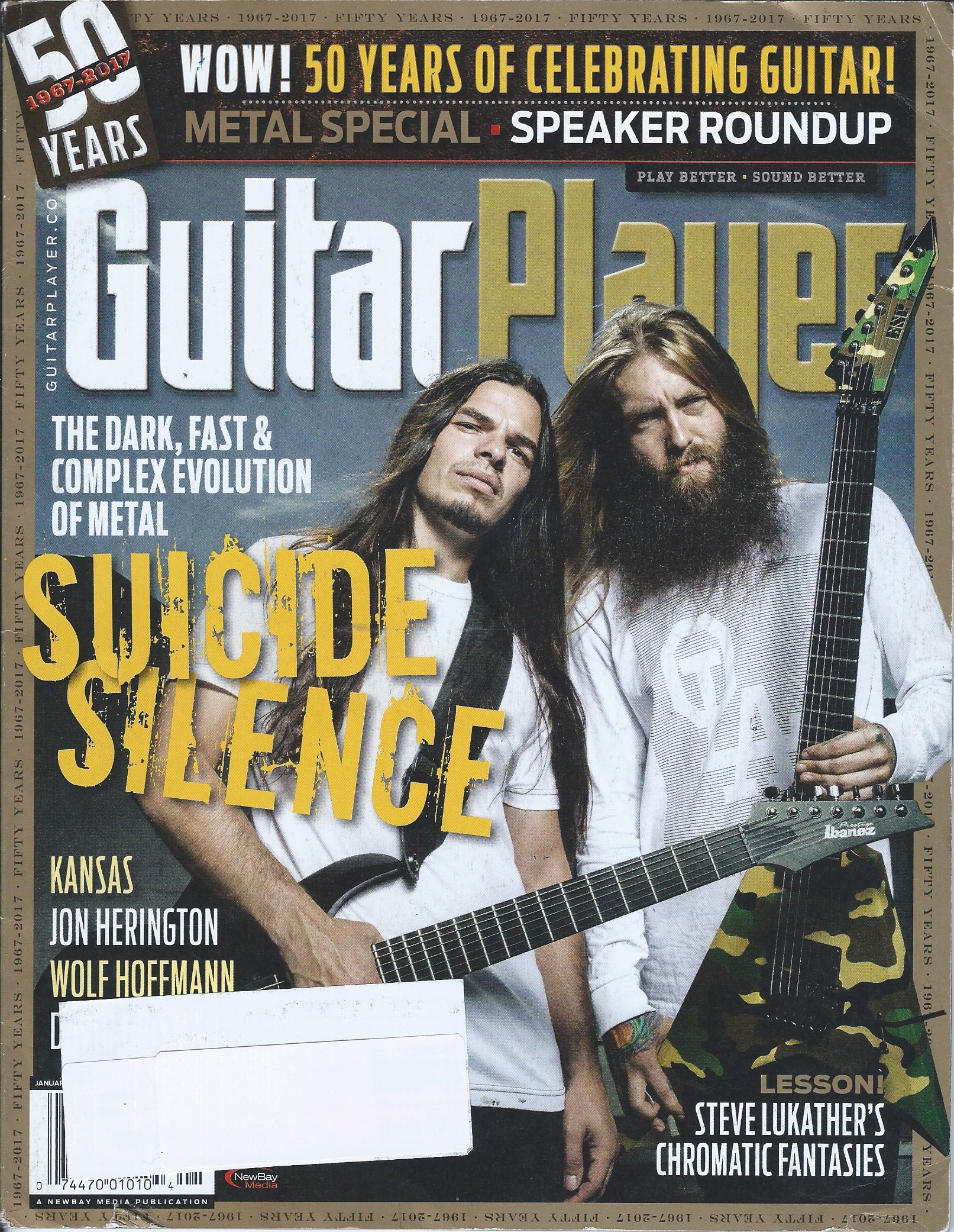
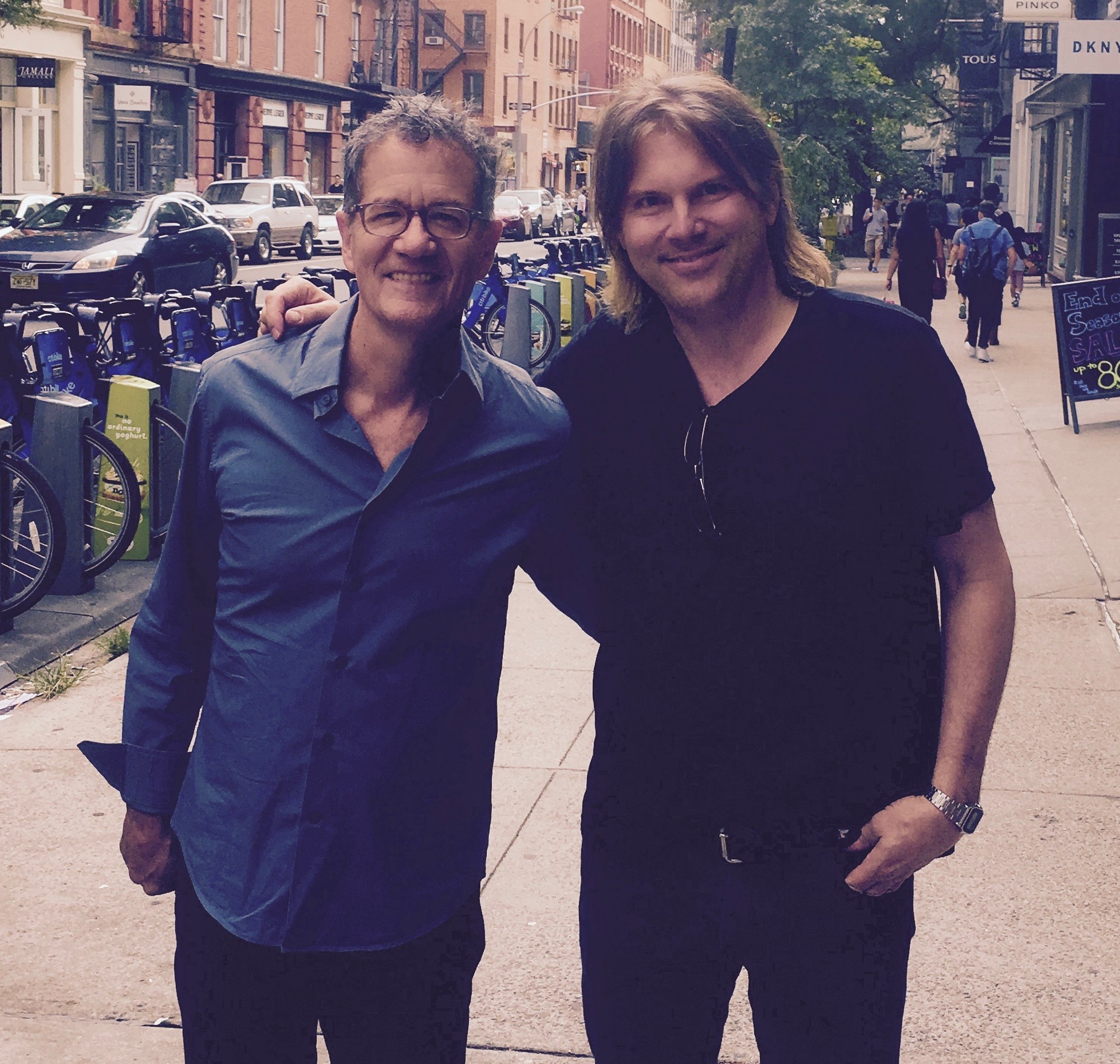
FRETBOARD JOURNAL INTERVIEW July 2011 (click for more)
For the last decade or so, Jon Herington has been playing alongside Donald Fagen and Walter Becker at Steely Dan tour stops. Night after night, he’s performing some of the most complicated arrangements ever crafted for pop music, playing parts originally forged into our memories by guitar legends such as Jeff “Skunk” Baxter and Larry Carlton. Yet, as anyone who has caught Steely Dan recently can attest, Herington is living up to this monumental task. The NYC-based musician, who also plays alongside Madeleine Peyroux and has his own solo career, made time to talk to the Fretboard Journal before his recent Seattle tour date. Look for a longer piece with Herington in a forthcoming Journal. (click for more)
Home Interview: Jon Herington of Steely Dan
Fretboard Journal: How did you get the Steely Dan gig?
Jon Herington: I was asked to do some overdubs on Two Against Nature, which is the first Steely Dan record in this more recent phase of recording. I think it had been about 18 years since they have done Gaucho. It was toward the end of the overdub stage that I got a call.
I did maybe four or five sessions and played on, I think, four tunes for that record. Somewhere in the course of the sessions they asked me if I was interested in going on tour. I said of course. So that was that.
FJ: Didn’t you tell me you had an excruciating story about your first Steely Dan song?
JH: Oh yeah. Walter [Becker] called me and I came in and played on “Janie Runaway.” We worked for about four or five hours and it seemed to go well. I was reasonably comfortable and they seemed happy with what I was doing; we just played the one tune over and over with a lot of takes, but it seemed to go well. At the end of the session they said goodbye and Walter asked, “Are you in town? Are you going to be around for a while? I’d like to have you come back in next week and play some more.” And I said, “Yeah, I’m around and I’d love to.”
A week goes by with no phone call. Two weeks go by, no phone call. Three weeks go by… So, I gave up on him, tried to recover and move on. Then, about five weeks after that, he did call. So maybe his sense of time is different from mine!
On the phone, he said, “Remember that tune you played on, a couple weeks ago?” I said, “Yeah, I remember.” He said, “Well, we’re not using anything you did from it.”
Then he said, “But we’d like you to come in and play on some other stuff.”
He was messing with me a bit, but he was right, they didn’t use anything that I played on that first tune. But I came in and I did survive. I did four other tunes, or so. And that was my introduction to Walter Becker.
FJ: Steely Dan must have one of the more fanatical fan bases around. And every night, you’re asked to play on these incredibly complex tunes that the fans have committed to memory, both note and tone-wise. How do you approach a gig like that?
JH: I certainly don’t try all the time to get the sounds that are on the records. For one, it would be really difficult to do. But I often will go for something sort of similar, just because it does seem like what the tune calls for, often. For instance, on “Peg,” it would probably sound a little odd not to use a sort of cranked up sound that has some sustain and distortion.
FJ: I was actually going to ask you about the “Peg” solo that you’re performing. Is it an alternative to the slide part on the record?
JH: The beginning of it? No, it’s not slide, he just bends two strings at once. It’s the two-finger bend. Not easy to do.
But you know, we’re also doing a tune called “Your Gold Teeth.” It’s kind of a jazzy tune and there’s some restraint about it. On the record, the sound is clearly a rhythm pickup, but I don’t know what kind of guitar it was or anything — it’s certainly a clean tone on the rhythm pickup. It sort of sounds like the right thing for that. It’s a bit jazzy, but not too much. I tend to sort of go with general sort of things like that.
Most of the solo sounds might be the stuff that Larry Carlton did. Almost inevitably, it’s a Gibson guitar and it’s often his 335. Jeff Baxter played a lot of different guitars, I think. But because Walter is playing Strats by [Roger] Sadowsky all night long, I probably use the Gibson more than the Tele. It’s a natural complement to his tones.
But there are some tunes where the Fender seems like the right thing because it was closer to what was on the record. I’m not that careful to figure out what guitar it was originally and duplicate the tones, but I certainly want it to sound like it fits with the song.
The other thing is that I have to be comfortable with the sound. If I’m not, it just doesn’t feel right and I can’t play well. So, sometimes I make a choice to go with the sound that frees me up to play in a looser way than to try to imitate what the sound is on record.
The challenge with this gig is to find a way to keep the level of quality of the playing — the soloing — up high, because the records are so great that way. Also, to make sure there’s room for me to do something that’s fresh and spontaneous and not feel locked in to repeating myself all the time. People know the guitar solos on the records better than I do sometimes.
That’s the great thing about the gig, because you can play with the audience’s expectations. You can’t do that on a gig if they don’t know the music, but if they’ve heard the records, then they’ll be coming with a sort of understanding. You can give them what they’re expecting or not … you can tease them; you can play with them. You wouldn’t have that power in a gig if it weren’t well-known music or the audience didn’t know the stuff.
FJ: How much time were you given to study these tunes before going out on tour?
JH: The first time I went on the road, I think it was in 2000, it seemed like a really tall order to learn all these tunes. There were so many guitar solos! I remember talking to Donald [Fagen] about “Bodhisattva,” which I found very difficult to play — just difficult changes to play through and a style was a little strangely hybrid to me. I couldn’t find a natural, comfortable way to tackle it right away from the beginning.
So I said to Donald, “Don’t you thing that would make a great saxophone solo?” He just chuckled and walked away. But I was definitely overwhelmed; there was so much to learn. I like to be over-prepared and I definitely was not.
I remember one lesson I’ve learned: I think our first tour was in Japan and there were a lot of tunes on the list that we hadn’t done very many times. I had charts for those. But charts on these tunes … some of them were like five or six pages long!
So I got them all taped together and I didn’t want to use a music stand. I thought that would look a little silly. So, I have these charts on the floor by the pedal board.
On a lot of these tunes, I knew basically everything except for one little section. But this is a six-page chart, so I’m just kind of groovin’ along on the parts that I know and all of a sudden this section comes up and I realize I have no idea what’s coming next. So I’m down there searching, trying to find my page, because I wasn’t really paying attention for the parts I knew and I could never find the spot!
I learned my lesson at the one gig I played that way. I went home and made a promise to myself to not do that again. I just stayed up all night and studied and studied until I had everything memorized.
Since then, except for the occasional surprise tune, which they might call on the spur of the moment — which nobody knows — basically no more charts for me.
FJ: You have both an enviable and scary job!
JH: That’s true. But they’re so cool to work for and they’re so easy to work for. It’s a great band; there are no weak links in this chain.
PERFORMING MUSICIAN (Interviewer: Paul Tingen) (click for more)
Since 2000, Jon Herington has picked up the baton from Randall, Carlton, Parks, Ritenour, Knopfler and so on, and by all accounts he’s the most successful. A look at the Dan’s live DVD Two Against Nature: Plush TV Jazz-Rock Party In Sensuous Surround Sound (2000), or at a selection of the enormous amount of post-2000 Steely Dan live clips on YouTube, shows that Herington manages the impressive
feat of paying homage to the classic solos by his famous predecessors, while at the same time taking them to a new level. Judging by comments from live critics in the media, as well as YouTube viewers, Herington in many cases steals — or perhaps steels — the show. So what’s his secret? (click for more)
The following was taken from an interview by Paul Tingen and published in Performing Musician magazine in March, 2009. (Used by permission)
“Donald and Walter have a reputation for being very fussy when it comes to recording in the studio,” replies Herington, on the phone from his home in New York. “It may therefore surprise people that they don’t give me any directions and almost never comment on what I play. This offers me amazing freedom. My starting point is what’s on the record. I love the recorded music, and I’ll take something from that and then run with it. It may be the sound of the guitar or a signature line that was improvised in the studio but has become so well known that it has become a hook in the music. These lines have become part of the arrangement and it would be wrong not to play them.
“I strike a balance between honouring the original stuff and finding room for me to take it somewhere else. In cases where I do not trust myself to improvise at the same level as the recorded music, I prepare a solo at home. But I often find during the course of a tour that my approach will change and the solo needs no scripting, and in the end I’ll just go for it. In other cases, with solos that I decided not to script, I find things on the job that are really effective and I do them again the next night. So some solos that were completely open-ended at the beginning of a tour might have some kind of predetermined shape by the end. For me, it’s all about finding out what the songs need. I do my best to make the big picture feel right, and not to get lost in guitar world.
“Donald and Walter are big jazz fans and they want you to improvise. They don’t want to just recreate the studio recordings; they want their live band to add something compelling and fresh to each live performance. Improvising is a wonderful thing and if I didn’t do it I would feel like I’d really be missing out on something. But at other times, it’s best for the music to simply play your part as best as you can. In that case, the skill is to be able to play as compelling as possible so that it sounds as if you’re improvising, or like it’s the first time you’re playing the part, or perhaps the last time you’ll ever play it! It’s the big challenge in live performance and it’s made easier in Steely Dan, because we’re talking about a really precise rhythmic machine and real attention to detail in terms of timing, tension, feel, groove and what makes the music beautiful to play into. The music can sound deceptively simple, but there’s usually a curve coming at you [laughs]. And it’s such a great hybrid! If you’re not familiar with jazz, you’re not going to be able to negotiate these harmonies, so you have to have jazz training and jazz sensibility. Yet at the same time, I’m almost always using rock and blues guitar sounds.
Less Schizophrenic
“My starting point is what’s on the record. I love the recorded music, and I’ll take something from that and then run with it.” So what allows the extremely talented, but relatively unknown Herington to improve on classic solos by some of the greatest names in rock and jazz? One of the main weapons in Herington’s arsenal is that he effortlessly straddles the divide of rock and jazz, something that’s a must for every Steely Dan musician. In addition to this, he reaps the benefit of an unusual combination of extreme dedication to detail, love of lyricism, and a music-comes-first attitude. The fact that he initially learned to play piano and saxophone may also have something to do with his music-centred attitude. Herington was born in New York in 1954, picked up a guitar for the first time around the age of 10 or 11, and for the next few years he taught himself how to play the instrument. “I always felt like a student of music,” recalls Herington, “and that helped me when I began playing the guitar. I started sitting with the guitar in my lap and dropping the needle onto my favourite records, which were mainly by the Beatles and later on also Led Zeppelin, the Stones, Cream, Hendrix, Van Morrison, Joni Mitchell, Bob Dylan and so on. I improved from all the practice on my own and from playing in rock bands during my high school years. But when I went to college I met a few players who were much better equipped technically. This made me sort of embarrassed, and I decided to get serious and look for a teacher. I did a guitar workshop with Ted Dunbar and he recommended a local guitar teacher called Harry Leahey, who was unbelievably generous and knowledgeable. I studied with Harry for many years.” Formal music education led Herington into the realm of jazz, as Leahey was a jazz guitarist, who in turn had studied with the legendary Philadelphia-based Dennis Sandole, a jazz guitarist who taught, among others, saxophonist John Coltrane. After completing his studies with Leahey, Herington also enjoyed some lessons from Sandole, and studied composition and music theory at college. During this time he immersed himself completely in the world of jazz, to the exclusion of other genres. On the positive, this narrow focus reflected his attention to detail and led him to master the skills and idioms required in jazz. On the negative, it contributed to an ongoing search for his own musical identity. “When I was studying rock music, I wasn’t concerned with sounding like myself; I wanted to sound like Jimmy Page! When I studied jazz, it was the same. I sold my Les Paul and bought myself a Gibson Johnny Smith guitar with F-holes and went all-out for that jazz sound. I don’t think I bent a string for six years! [Laughs] I was in one world for six years and completely shunned rock, so later on I had to work hard to balance these two worlds and try to be a little less schizophrenic stylistically. Even today my tendency is to play with a jazz sound when I’m playing jazz and to use a rock sound for rock.” While Herington has played out-and-out rock and jazz, unsurprisingly most of his musical career has straddled the sometimes-awkward territories where the two meet. During the previous three decades, he’s appeared on albums by Michael Brecker, Jim Beard, Chroma, Bob Berg, Bill Evans, Lucy Kaplansky, Mike Stern, Billy Joel and, of course, Steely Dan, as well as solo albums by Fagen — Morph The Cat (2006) — and Becker — Circus Money (2008). Herington has performed with many of the above, plus with Bette Midler, the Blue Nile and Boz Scaggs. The guitarist has also completed two solo albums, filled with instrumental jazz-rock on The Complete Rhyming Dictionary (1997, re-released by ESC in 2007 as Pulse And Cadence) and rock & roll songs on Like So (2000). A third solo album, again with songs, is in the works. “The Complete Rhyming Dictionary/Pulse And Cadence basically reflects the music I was steeped in at the time,” explains Herington. “I was listening to a lot of Weather Report, because they were the most inventive writers in the jazz-rock genre. They didn’t have a guitar player, so my album is me trying to craft a Weather Report-influenced sound with the guitar at the centre. It was remastered and slightly edited for the ESC release. I work mostly as a freelance guitarist, and for some reason my interest in writing songs and singing was revived, and this resulted in Like So, which is my take on the music of the era of the Beatles and the Rolling Stones, which was my first love.”
Freedom and Voice
The Complete Rhyming Dictionary was responsible for getting Herington the Steely Dan gig. In the late ‘90s, during sessions for Two Against Nature, Fagen and Becker asked keyboardist Ted Baker if he knew of a suitable guitar player. Baker happened to have a copy of Herington’s album with him, played it to the duo, and a call to the guitarist soon followed. Playing with the Dan has since been a large part of Herington’s life, presenting him with his biggest challenge to date in integrating jazz and rock. The guitarist relates how it helped him to find his own voice. “We probably do a week to 10 days of rehearsals before each tour, starting with the rhythm section and then adding the horns and the singers. We will typically settle on a master list of about 30 to 35 tunes, of which there’s a core of 10 to 12 tunes that we’ll play every time, maybe five or six that hardly ever get called, and the rest varies per evening. When Donald and Walter feel a tune has been played too much, they’ll give it a rest for a while. So it’s never the same. “The great thing for me in playing with Steely Dan is that, even as their repertoire changes to some degree from tour to tour, I have this opportunity to explore the same kind of music really deeply. The freelancer’s curse, which I have suffered from for years and years, is that you may play in one style for a couple of hours during a session and then you’re not asked to play this style again for another six months. This makes it really hard to see any growth in any side of your playing, except for your ability to think on your feet. Freelancers can adapt very quickly, which is good, but you don’t get into something that evolves over time. “I have always wondered why I don’t sound like myself; why I always sound like the guitar players I revere — like, for instance, George Benson, the greatest guitarist on the planet. But if you think about it, Benson has been playing the same kind of gig since he was a teenager, in the same style, with the same guitar and the same musical vocabulary. His live work is a continuing opportunity to do the same thing again and again, and that is what creates an amazing, effortless fluency in a particular style. “I’ve been with Steely Dan for eight years now, which is my longest gig so far. I’ve managed to narrow the focus of my work, and I feel grateful and happy that I’m much more comfortable tackling certain things than I was eight years ago. I’m more solid in my approach and I have much more options than I used to have. When I get back to a particular song a year later, I can now simply pick up where I left off and ask myself, ‘OK, what else can I do?’ And it’s the same music that I get to rework each time, so there’s an accumulation of ideas, of a vocabulary, and it changes the way I sound.” When playing with Steely Dan, Herington’s sound, particularly for soloing, is for the most part warm, thick and distorted, and driven by a very lyrical and melodic approach, featuring much bending of notes. Most of all, it’s his choice of notes that impresses. “Sometimes I feel it would not hurt to have some more tricks in my arsenal,” explains the guitarist, “and I do a little bit of tapping and things like that. But it’s more natural for me when I am playing a solo to work with lyricism and melody. I like musical solutions. It’s one thing to have the technique to negotiate difficult harmonies and fast tempos, but often it’s harder to play something simple and really beautiful! “For me, the key to lyricism is the connection with the voice, to be singing through the guitar. That’s why I love bending strings, because it’s related to singing. It’s so expressive. The same thing with playing slide. When I’m away from the guitar and listen to a song, I often imagine the notes of a solo and what would sound like a vocal melody to me. All my guitar study has been about being able to immediately play what I hear in my head without a mistake. The closer you get to that, the more free you feel in music.”
Jon Herington’s gear box
When playing with Steely Dan, Jon Herington’s lyrical, melodic approach to the guitar is performed mainly on his Gibson CS336, and occasionally on a Fender Telecaster, and a Hamer Talladega Pro. The use of the half-acoustic 336 and the Telecaster are in line with Herington having one foot in the jazz and another in the rock camp, but, strangely, he appears to have reversed their uses; the 336 plays the more distorted material, while the Fender is used mainly for more clean playing.
“Walter is playing Sadowsky Strats all the time,” explains Herington, “so it works well if I have a different sonic approach from him. This is what led me to using the 336. It has a beautiful, wide range of tone that’s very good for playing Larry Carlton’s solos from the ‘70s and it also works well for jazzy, big fat rhythm guitar voicings, playing big chord changes. It’s the most comfortable lead guitar that I have, and the small body size means that it doesn’t feel as strange when I change to another guitar.
“In general, I prefer Gibsons, but Fenders have a certain sound and are more suited for playing clean, funky rhythm guitar, so I use the Telecaster on songs like ‘Show Biz Kids’, ‘I Got The News’ and so on. The Telecaster also complements Walter’s Strat, and sits better in the mix for certain single-note and/or muted-picking lines and R&B. My Tele has the treble pickup rewound to eliminate squealing, and a Van Zandt middle pickup was also added. It’s quite capable of a good solo sound and I play some solos on it, but mostly I find myself going towards humbucker pickups.
“My favourite electric guitar strings are Ernie Ball Rock ‘N’ Roll (pure nickel wrap), 10-46. Besides the greater ‘bendability’, there’s a certain ‘snap’ that’s only possible with lighter strings. For jazz guitars, I’ll use heavier strings. Contrary to what’s reported on the Internet, I don’t use a wireless anymore. Cables just seem simpler and they also sound better to me. I don’t use rackmount gear any more, so the wireless was an extra piece that didn’t seem worth bothering with.”
Amps and effects (edited and updated - JH, 2010)
“I have greatly simplified my on-stage setup over the years of playing with Steely Dan and I can now basically do the job with a guitar, a tuner, a delay and a reverb pedal and an amplifier. My amplifiers are a Guytron GT100 and a GT100 F/V, which is an updated version of the same amp. I carry two so I have a spare in case of an emergency. They’re great amps with two channels (one clean and one dirty), a great effects loop, two power stages (resulting in a unique and great master volume capability), and a beautiful sound. I use them with a single Guytron GT212 cabinet loaded with two different Celestion speakers. One is a Vintage 30 type and the other more a Greenback type with higher power-handling capacity. Recently I've also been using an amp made by Bludotone which I like very much.
“For most solos, I go straight to the amp with a bit of a single, short delay and a bit of reverb, and that’s it. My pedalboard these days mainly consists of what I call problem solvers. I have a Boss pedal tuner and a volume pedal, so I can mute to tune. I also have a wah-wah pedal, and a boost pedal with a buffer. The buffer makes sure that I don’t lose too much signal on the way to the amplifier, and I use the boost for when I switch to the Telecaster. Very occasionally, I solo with my rhythm pickup, but if I use the dirty channel, it will sound too dark. So when I switch to the rhythm pickup, I go to the clean channel and use a Tube Screamer to boost the signal. The pedal imitates what it would sound like if I went back to the amplifier to adjust the controls, because I don’t have time to do that live. But I don’t go for that sound very often. Plus I have a tremolo pedal and a couple of delay pedals, but I don’t use them very much either. At the end of the chain before the amp input I now use the Xotic EP Booster, which I leave on all the time as it adds something really nice to the overall sound.””
JON HERINGTON'S NEW FRONTIER: RENOWNED STEELY DAN GUITARIST DISCUSSES HIS MUSICAL JOURNEY (Interviewer: Joan K. Smith) (click for more)
The reality of being an artist, with few exceptions, involves having a day job, something that pays the rent and, most importantly, buys the stuff -- paint, guitar strings, reeds, canvas, whatever -- that makes the self-expression you live for possible. For too many, the day job is a generally uninspiring affair that entails some manner of serving, teaching, or selling out. (click for more)
Not so for Jon Herington, whose recent CD Shine (Shine Shine) has just been released. He hit the day job jackpot over 11 years ago when he landed, as he describes it, "the best gig in the world," as guitarist for jazz-rock legends Steely Dan. Anyone who knows Steely Dan's music, shaped with intense perfectionism by principals Walter Becker and Donald Fagen, understands that "best" is in no way synonymous with "easy." Start with the complexity of their compositions and arrangements, plus an uncompromising demand for excellence from their players; add to that the fact that many of Steely Dan's classics are practically defined by the signature solos of a veritable pantheon of modern guitarists; and it's clear that Herington is charged with a task that would be daunting to most musicians.
About those solos, Herington relates that it is a fine line to walk: He feels that diehard Steely Dan fans coming to their concerts might feel "violated if a guitarist went too far from the original, or cheated if it was played exactly like the record." His solution is to discover some signature characteristic about the original, from an amp setting to a general approach, and incorporate a bit of that into his own iteration, "in a way where I can come up with stuff that's my own but doesn't dishonor the original music."
The end result: From the "Reelin' in the Years" intro where, he says, it would be "inconceivable" to play unlike the recording, to a more slanted reference to the original with his "Peg" solo, his work is rendered with a stunning, crystalline precision, and consistently garners standing ovations. He has earned a loyal fan following and critical acclaim from those who know him only through his Steely Dan performances. So powerful has his Steely Dan connection become that many of those fans are surprised to hear that he has his own solo career, one that involves not only songwriting but singing. They would also be surprised to know that guitar was not a first instrument, and that he wasn't necessarily a prodigy in childhood.
He did exhibit an early love for music, with grade school basement bands (he played piano, saxophone, and later, guitar), and his hunger for unlocking the design of rock/pop music he heard on the radio. "If I heard something I loved the sound of, I needed to take it apart and understand it, I was totally compelled to figure out how it worked." By high school he had a band that opened on several occasions for fellow New Jersey native son Bruce Springsteen, but by his own admission he played his three instruments "equally poorly" due to lack of discipline for technical practice.
The wakeup call didn't come until he began college. A freshman year dorm buddy at Rutgers, upon discovering they both played sax, suggested they have an impromptu jam session. In the space of 30 seconds of playing together, Herington found himself "staring into the void ... realizing this guy could play circles around me. I knew then I had to get my shit together."
He decided he needed to focus on one of his three instruments and learn to play it very well if he was ever to compete on a serious level. Guitar won out. He buckled down on studying jazz guitar in particular, studying first with Ted Dunbar at Rutgers, then privately with Harry Leahey and Dennis Sandole (who also was a maestro to John Coltrane, James Moody, and Pat Martino, among other luminaries).
He describes his first release in 1992, The Complete Rhyming Dictionary (rereleased in 2008 as Pulse and Cadence), a jazz-fusion instrumental conceived as an homage to the spirit of Weather Report, as "the end of a big era of music making for me ... the closing of a chapter."
After years of performing contemporary jazz guitar with the likes of "aggressive players" like Bill Evans, Michael Brecker, Randy Brecker, and the circle of players from Wes Montgomery's Indianapolis circle, he had decided that this realm of music "wasn't that promising," and went back into a singer songwriter role for his own work, eventually resulting in his 2000 release Like So.
In his latest outing, Shine (Shine Shine) Herington takes a less layered, "stripped down power trio" approach, which he describes as going back to his early blues-rock, bar band roots. His two bandmates, bassist Dennis Espantman and drummer Frank Pagano -- with whom he's been playing since the late 80s -- both contribute to the songwriting and singing in a club-friendly collection that also appeals to his fan base from the Steely Dan universe by featuring the guitar more prominently.
Steely Dan commences a new tour in July, but in the meantime Herington is promoting his own work, and already has a new Jon Herington Band release in the works for late 2011 or early 2012. His goal at this point? "To keep my own band going ... not just between the cracks of other gigs but to keep up the momentum and make it a viable thing on its own," he says. "It's the last dream frontier for me."
Joan K. Smith
Philadelphia-based artist, cultural critic, and independent curator
Posted: 04/19/11 11:53 AM ET

Image courtesy of Tony Kukulich